
Quick Answer: When weighing a kitchen remodel vs room addition San Diego homeowners often ask which delivers better value—in San Diego, a kitchen remodel typically costs $45,000–$110,000 and a room addition runs $80,000–$250,000+ depending on size and lot constraints. Kitchens usually deliver a stronger cost-to-value ratio (roughly 60-80% recouped), while additions add square footage that raises appraised value but take longer to permit. Coastal lots near the bluffs face stricter Development Services Department review, which affects timeline more than budget for either project.
You’ve got a dated kitchen, a cramped floor plan, or both, and you’re trying to figure out where your remodeling dollars actually work harder in San Diego. Here’s the direct answer: a kitchen remodel usually returns more value per dollar spent, but a room addition solves problems a kitchen remodel can’t touch, like a second bedroom or more livable square footage. In San Diego, your decision often comes down to lot size and coastal zone permitting rather than personal preference alone, since older neighborhoods near the coast have tighter setback and height rules than inland areas. This guide walks through real costs, resale value data, permit realities, and the specific lot and zoning issues that decide whether an addition is even feasible on your property. Get a free estimate from a licensed San Diego contractor before you commit to either path.
Kitchen Remodel or Room Addition: Which Costs More in San Diego?
A room addition costs more than a kitchen remodel in San Diego, almost always. A midrange kitchen remodel runs $45,000–$75,000, a high-end kitchen remodel can hit $110,000+, while a single-room addition typically costs $80,000–$250,000 depending on size, foundation type, and whether you’re adding a bathroom.
The gap comes down to what you’re actually building. A kitchen remodel works inside your existing footprint and roofline. A room addition means new foundation work, new framing, a new roofline tie-in, and often new electrical and HVAC runs from scratch. That’s a different scope entirely, and San Diego’s Development Services Department reviews additions far more closely than interior remodels.
| Project Type | Typical Cost Range | Timeline | Permit Complexity |
|---|---|---|---|
| Midrange kitchen remodel | $45,000–$75,000 | 6–10 weeks | Low to moderate |
| High-end kitchen remodel | $85,000–$110,000+ | 10–14 weeks | Moderate |
| 12×12 single room addition | $80,000–$140,000 | 4–6 months | Moderate to high |
| Full room + bath addition | $150,000–$250,000+ | 6–9 months | High |
Kitchens cost less because you’re not touching the building envelope. Additions cost more because you’re expanding it, which triggers a longer plan check with San Diego’s Development Services Department and, on coastal-adjacent lots, potentially a Coastal Development Permit review layered on top of the standard building permit.
Which Adds More Resale Value in San Diego, a Kitchen or Extra Room?
A kitchen remodel generally recoups more of its cost at resale in San Diego, typically 60-80%, compared to a room addition’s 50-65% cost recoup. But that’s not the full story, because a room addition adds appraised square footage that a kitchen remodel simply can’t.
Buyers touring San Diego homes react fast to kitchens. It’s the room that sells the house in the first ninety seconds of a showing, and appraisers weigh updated kitchens heavily in comparable sales. A remodeled kitchen with quartz counters, updated cabinetry, and new appliances signals the whole house has been cared for, even if the bathrooms haven’t been touched.
Room additions play a different game. If your home is a two-bedroom in a market where three-bedrooms sell for $60,000–$100,000 more, adding that third bedroom can outperform any kitchen upgrade on paper, because you’re changing the comp category your home competes in, not just polishing what’s there. A homeowner in the Del Mar Heights area recently added a 280 sq ft primary suite to convert a two-bedroom into a three-bedroom home, and their listing agent estimated the addition alone shifted their expected sale price by roughly $85,000 based on nearby three-bedroom comps.
So which wins? For most San Diego sellers, if your home already has the right bedroom count, the kitchen remodel wins on ROI. If you’re short a bedroom compared to what similar homes in your area offer, the addition often wins on total dollar impact, even with a lower percentage recoup.
What Is the 30% Rule and Does It Apply to San Diego Remodels?
The 30% rule says you shouldn’t spend more than 30% of your home’s current value on a single remodeling project, or you risk over-improving for your neighborhood. In San Diego, this rule applies but needs local context, because home values vary sharply block to block.
A $700,000 home following the 30% rule tops out around $210,000 in remodeling spend before you’re likely over-improving relative to what buyers expect nearby. That number looks completely different for a home valued at $1.4 million, where a $210,000 kitchen-plus-addition combo is well within reason.
Here’s where it gets tricky in San Diego specifically. Coastal-adjacent neighborhoods often have wide value swings within a few blocks, since ocean proximity, view lines, and lot elevation move prices independent of square footage. Before committing to a project size, it’s worth pulling recent sales on your specific street, not just your ZIP code average, because the 30% rule only works if you know your real ceiling.
Honestly, most contractors will tell you the 30% rule is a starting guideline, not a hard limit. If you plan to stay in the home 10+ years, spending above 30% for a project you’ll actually enjoy living in makes sense. If you’re planning to sell within 2-3 years, staying under that threshold protects your investment.
When Does a Kitchen Remodel Make More Sense Than an Addition?
A kitchen remodel makes more sense when your home already has enough bedrooms and bathrooms for your household and your local market, and the layout or finishes are simply dated. If the bones of your home work and only the kitchen feels stuck in 1995, that’s your answer.
Kitchen remodels also make sense when your lot can’t physically support an addition. Many older San Diego neighborhoods sit on lots with tight side-yard setbacks, and a kitchen remodel sidesteps that problem entirely since you’re not expanding the footprint.
Budget matters too. If you’re working with $50,000–$90,000, that money goes much further inside a kitchen remodel than toward a partial addition, where you might run out of funds mid-framing. A full kitchen transformation at that budget, new cabinets, quartz or quartzite counters, updated appliances, new flooring, delivers a finished, sellable result. The same budget spread across an addition often leaves you with an unfinished shell.
And if your goal is faster turnaround, kitchens win here too. A remodel finishes in 6–10 weeks, while additions run 4–9 months once you factor in plan check, permitting, and construction. If you need the project done before a life event, a move, a sale, hosting family, the kitchen is the realistic choice.
When Does a Room Addition Make More Sense Than a Kitchen Remodel?
A room addition makes more sense when you need square footage a remodel can’t create: an extra bedroom, a home office, or a primary suite. No amount of kitchen polish adds a bedroom count, and bedroom count is often the single biggest driver of resale price in San Diego’s market.
Growing families are the most common driver. If you’ve got a new baby, aging parents moving in, or kids who need separate rooms, an addition solves a real living problem that a nicer kitchen won’t fix. A homeowner in the Carmel Valley area recently added a 320 sq ft ground-floor bedroom and bathroom suite for an in-law arrangement, at a cost of roughly $165,000, because their existing three-bedroom layout couldn’t accommodate a live-in parent with mobility needs.
Additions also make sense if your kitchen is already updated but your home is undersized for its neighborhood. If every comparable sale nearby has 4 bedrooms and you have 3, that gap costs you at resale no matter how good your kitchen looks.
One more scenario: if your lot has the room to build out or up, and you plan to stay long-term, an addition builds equity you’ll use for years, not just at sale. That’s a different calculation than a remodel purely for resale timing.
How Do Lot Size and Coastal Zone Rules Affect Your Options in San Diego?
Lot size and coastal zone rules can eliminate a room addition as an option entirely in San Diego, regardless of budget. Before you fall in love with addition plans, you need to know what your specific lot allows.
Many older San Diego neighborhoods, particularly those platted decades ago, sit on lots with narrow side-yard setbacks and modest lot widths. A lot under 50 feet wide often can’t accommodate a ground-floor addition without a variance, which adds months to your timeline and isn’t guaranteed to get approved. In these cases, a second-story addition or a kitchen remodel becomes the realistic path forward.
Coastal zone rules add another layer. Properties within San Diego’s coastal zone boundary may require a Coastal Development Permit in addition to the standard building permit through the city’s Development Services Department, particularly for anything that changes the building footprint, height, or bulk visible from public viewpoints. This review process can add 2–6 months to your addition timeline, and it doesn’t apply to interior kitchen remodels at all, since those don’t alter the exterior structure.
This is the core reason so many San Diego homeowners on tighter, older lots choose kitchen or bathroom remodels over additions: the permit path is dramatically simpler, and the finished cost is far more predictable. If your lot sits in a coastal review area, talk to a contractor who’s navigated Development Services Department review before you draw up addition plans, since a room addition permit in these zones runs a genuinely different process than a standard inland build.
How Much Would a 12×12 Room Addition Cost in San Diego?
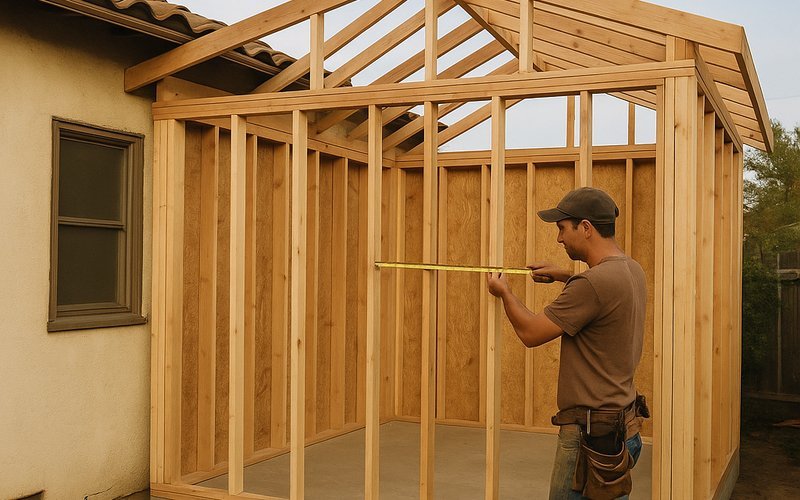
A 12×12 room addition, 144 square feet, typically costs $85,000–$140,000 in San Diego, depending on foundation type, finish level, and whether it includes a bathroom. That works out to roughly $590–$970 per square foot, which is higher than larger additions because fixed costs like permitting, foundation setup, and utility tie-ins don’t scale down proportionally with size.
Your biggest cost drivers on a 12×12 addition are foundation work, roofline integration, and whether you’re extending electrical and HVAC systems versus running new dedicated lines. A simple slab-on-grade bedroom addition with no plumbing sits at the lower end, around $85,000–$105,000. Add a bathroom or wet bar, and you’re pushing $120,000–$140,000 because of the added plumbing rough-in and venting requirements.
For a typical lot in San Diego, a 12×12 addition takes roughly 4–6 months from signed contract to final inspection, with plan check and permitting through Development Services Department typically eating the first 6–10 weeks of that timeline before construction even starts. If you’d like an accurate quote for your specific lot, this room addition cost breakdown covers line-item pricing in more detail.
Should You Do Both a Kitchen Remodel and an Addition?
Yes, combining both projects can make sense in San Diego, especially when you’re already opening up walls or pulling permits, since sequencing them together often saves money on mobilization and design costs. Combined kitchen-plus-addition projects typically run $180,000–$320,000 depending on scope.
The efficiency argument is real. If you’re adding a room adjacent to your kitchen, extending it into a great room layout, or building a new kitchen wing entirely, doing both at once means one design phase, one permit set, one construction crew mobilized on-site instead of two separate projects months apart. You also avoid paying for a kitchen remodel now only to tear into that same wall again in two years for an addition.
Budget is the real constraint here, not desire. Most homeowners who combine projects are working with $200,000+ in available funds, either cash, a renovation loan, or a HELOC against home equity. If your budget caps out around $100,000, doing one project well beats doing two projects half-finished.
Design-build firms handle combined projects more smoothly than hiring separate contractors for each phase, since one team manages structural, electrical, and finish work under a single plan set submitted to Development Services Department. That single-submission approach can shave weeks off your total permit timeline compared to two separate applications filed months apart.
How to Find the Right Remodeling Contractor in San Diego
The right San Diego contractor for a kitchen remodel vs room addition decision is a licensed design-build firm with direct experience navigating Development Services Department plan check and, if relevant, coastal zone permitting. Ask specifically about their experience with your project type, not just general remodeling experience.
Start by verifying their California contractor’s license through the CSLB, and confirm it covers the classification for your project, B general building for additions, or the relevant specialty classification for kitchen and bathroom work. Then ask these questions directly:
- How many room additions have you completed in San Diego in the last two years, and can you show recent examples?
- Have you filed permits with Development Services Department for a project in a coastal review zone?
- Do you handle design and construction under one contract, or will I need a separate architect?
- What’s your realistic timeline for plan check approval on a project like mine?
- Can you provide references from clients whose projects finished within the original budget?
Get at least three bids before deciding, and be wary of any bid that’s dramatically lower than the others, since that often signals corners will get cut on materials or permit compliance. A firm that’s upfront about timeline realities, including permit delays outside their control, is more trustworthy than one promising an unrealistically fast schedule.
If a bathroom remodel is part of your plan alongside the kitchen or addition decision, it’s worth reviewing options for bathroom remodeling in the Encinitas area at the same time, since bathroom work often gets bundled efficiently into a larger kitchen or addition project rather than tackled separately later. Whatever you decide, get a written scope, a realistic timeline, and a fixed-price contract before signing anything, and reach out to a licensed San Diego design-build team for a free walkthrough and estimate on your specific property.